Overview
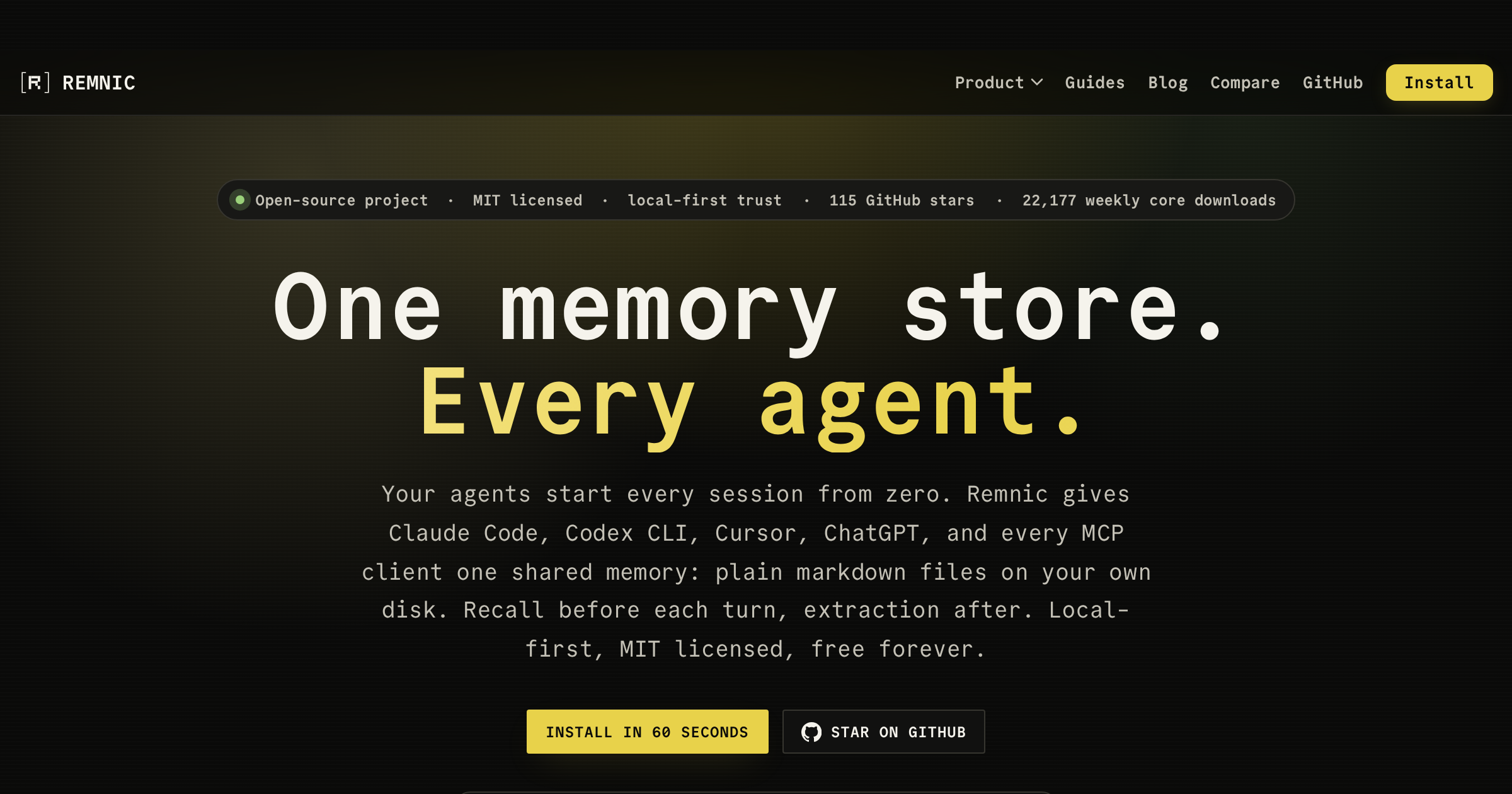
Remnic is a local-first memory system that lets different AI agents share durable context. It stores memories as human-readable Markdown files with YAML metadata on the user's machine, making them accessible to ordinary tools for inspection, editing, backup, and version control.
The same store can serve Claude Code, Codex CLI, Pi Coding Agent, Hermes, OpenClaw, ChatGPT, Cursor, and other MCP-compatible clients. This reduces repeated explanations and avoids isolating context inside a single assistant.
Key Features
- Scoped memory separates personal, work, client, project, repository, tool, temporary, and private context.
- Provenance records source, timestamp, scope, confidence, retrieval reason, and correction or staleness state.
- Hybrid retrieval combines BM25 and vector search with reranking and bounded recall budgets.
- Version snapshots preserve overwritten pages so changes can be compared or reverted.
- Background consolidation merges duplicates and promotes recurring themes while retaining provenance.
- Recall diagnostics explain which retrieval tier produced a memory and why it surfaced.
How Memory Works
Remnic uses a three-phase loop around each agent turn. Before a turn, it injects relevant memories through hybrid retrieval; after the turn, it buffers conversational context; extraction then identifies durable facts, preferences, decisions, and patterns and writes them to the file store.
Corrections and temporal supersession help prevent outdated facts from being treated as current. Memory-worth scoring filters low-value material, while project scoping keeps repository-specific knowledge separate from broadly reusable patterns.
Integrations and Models
Native integrations use combinations of hooks, plugins, extensions, MCP tools, and structural recall. A standalone HTTP and MCP server supports custom agents and self-hosted configurations, while authenticated access is available for clients that connect to the local service.
Extraction and reranking can use OpenAI, Ollama, LM Studio, Anthropic, Fireworks, Groq, vLLM, or other OpenAI-compatible providers. Multi-provider fallback chains are supported, and a local-model preset is available for offline-oriented operation.
Control and Availability
Users can inspect, correct, delete, rescope, copy, or back up memory through the underlying files and operator interfaces. Action-confidence signals are designed to help an agent decide whether to ask, draft, act, refuse, or escalate when context is incomplete, stale, private, or out of scope.
Remnic is open source under the MIT license and is presented as free, with no subscription required. Its modular packages cover the core engine, CLI, server, agent adapters, and import or export utilities.