Overview
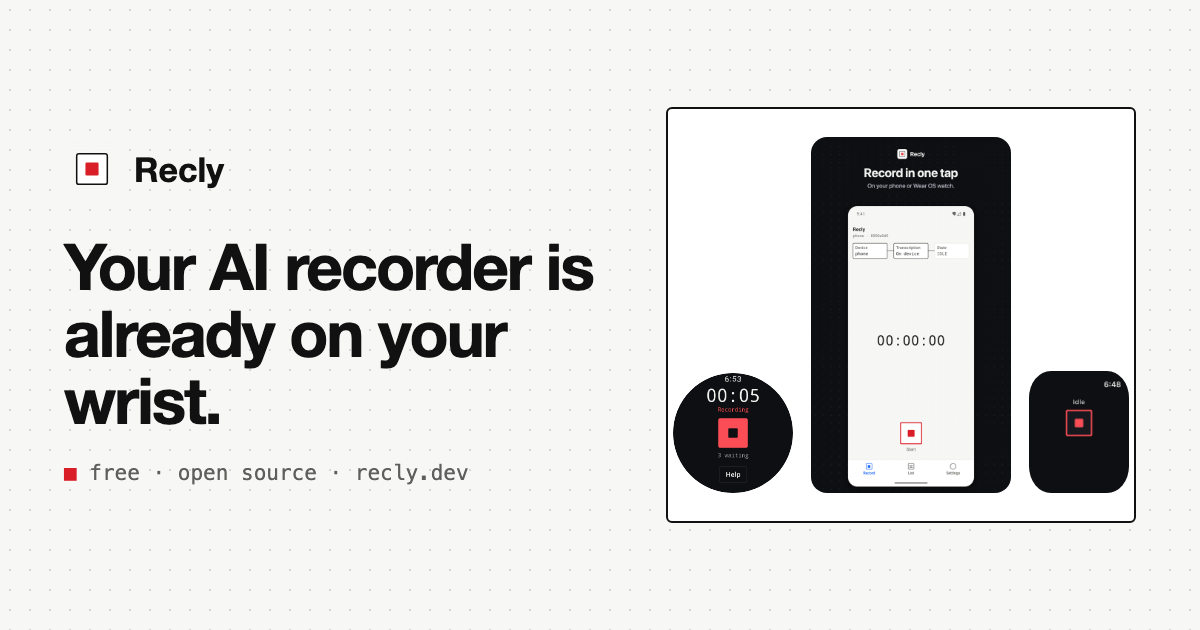
Recly is an open-source recording and transcription system for Galaxy Watch, Apple Watch, Android, iPhone, macOS, and Windows. It turns existing devices into a connected capture workflow while keeping recordings in the user's own Google Drive.
There is no Recly server, account, analytics service, crash reporting, or update ping. Transcription can run on the device, use a provider selected by the user, or be disabled while preserving the original recording.
Key Features
- Watch shortcuts start visible recordings that transfer to the paired phone.
- Desktop clients capture the microphone and the other side of supported online meetings as separate tracks.
- Interrupted uploads wait and retry, and originals remain until Drive confirms storage.
- Transcripts are saved as documented plain files beside their recordings.
- External transcription supports user-supplied credentials for 14 providers, with speaker separation where the provider offers it.
- The apps support 20 transcription languages, filtered by device engine or provider capability.
How It Works
A recording begins on a watch, phone, Mac, or PC. The phone or computer uploads the original to Google Drive; watches first hand audio to their paired phone, and offline recordings remain queued until a connection is available.
After storage is confirmed, the selected engine writes a transcript next to the audio. On-device processing sends no audio to a speech service, while external processing sends joined audio only to the provider explicitly selected by the user.
AI Notes and Privacy
Recly intentionally ends its pipeline at the transcript. The user's own AI agent can read that transcript and produce meeting minutes, decision logs, interview summaries, lecture notes, or memos; included example skills can place those notes in Notion.
Settings and provider credentials remain on each device rather than being synced. The project is licensed under AGPL-3.0-or-later, and its clients, data contracts, design documentation, and release process are available in the same source repository.