Overview
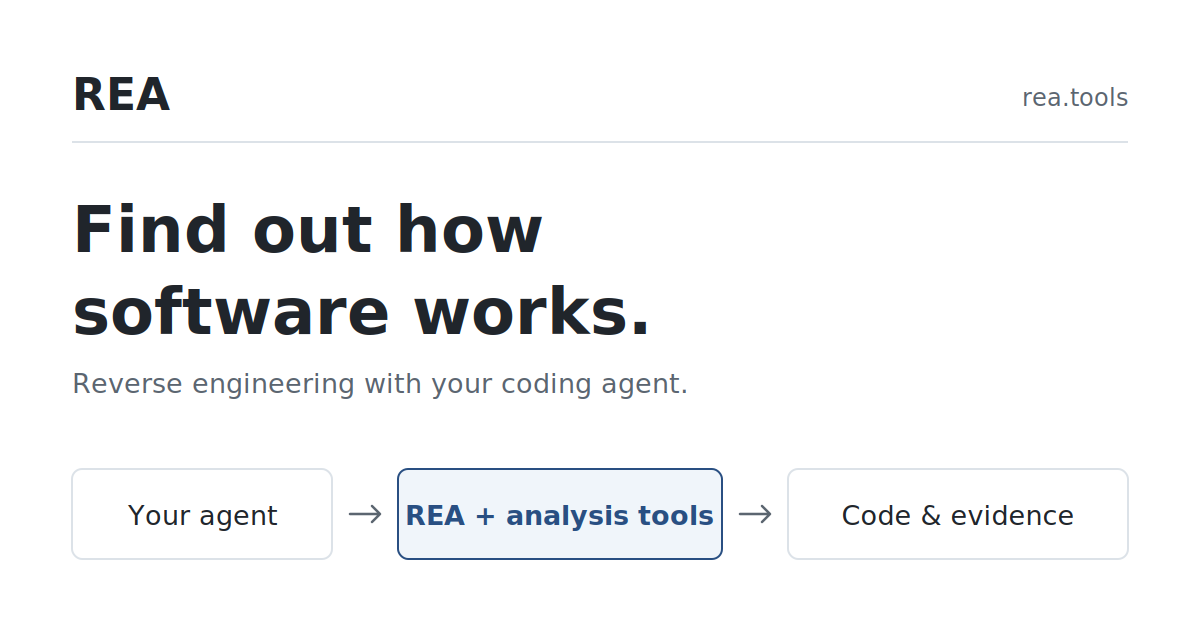
REA is a reverse-engineering toolkit for coding agents. It gives an agent access to program evidence so it can inspect how software works, explain a feature, and help reproduce or change the underlying behavior.
Its examples cover installed applications, executable code, JavaScript applications, and browser activity. The agent receives relevant code, instructions, calls, and runtime details, then turns those findings into a readable explanation or reconstruction.
Key Capabilities
- Inspects functions, strings, references, and call relationships in executables and libraries.
- Maps modules, routes, IPC, and native dependencies in JavaScript and Electron applications.
- Captures selected browser or process activity for comparison across runs.
- Returns loaded scripts, decompiled code, assembly instructions, and related calls for agent analysis.
- Supports checking reconstructed behavior against the inspected program.
How It Works
REA connects to a coding agent after setup and supplies the evidence needed for an investigation. A user can ask a question in plain English, while the agent uses REA to locate relevant branches, trace calls, identify values, and recover the software rule involved.
The site demonstrates this workflow with Windows Calculator. REA exposes the percentage handler and its operator branches, allowing the agent to explain why addition applies the percentage to the first number while multiplication converts the current number to a fraction of 100.
Example Investigations
A browser example inspects the script used by a dinosaur game. The recovered settings show a starting speed of 6, an increase of 0.001 per update without a collision, and a maximum speed of 13; the agent then uses that rule in a small reconstruction with an adjustable control.
REA also presents a guided Notes application investigation focused on tracing CSV export and checking behavior after changing an input. Broader targets include reconstructing gameplay from an executable and examining a website's implementation.
Supported Analysis Areas
REA organizes guidance around native binaries, JavaScript and Electron applications, and browser or runtime observation. These paths support investigations ranging from explaining one function to rebuilding a feature and testing the result against the original behavior.