Overview
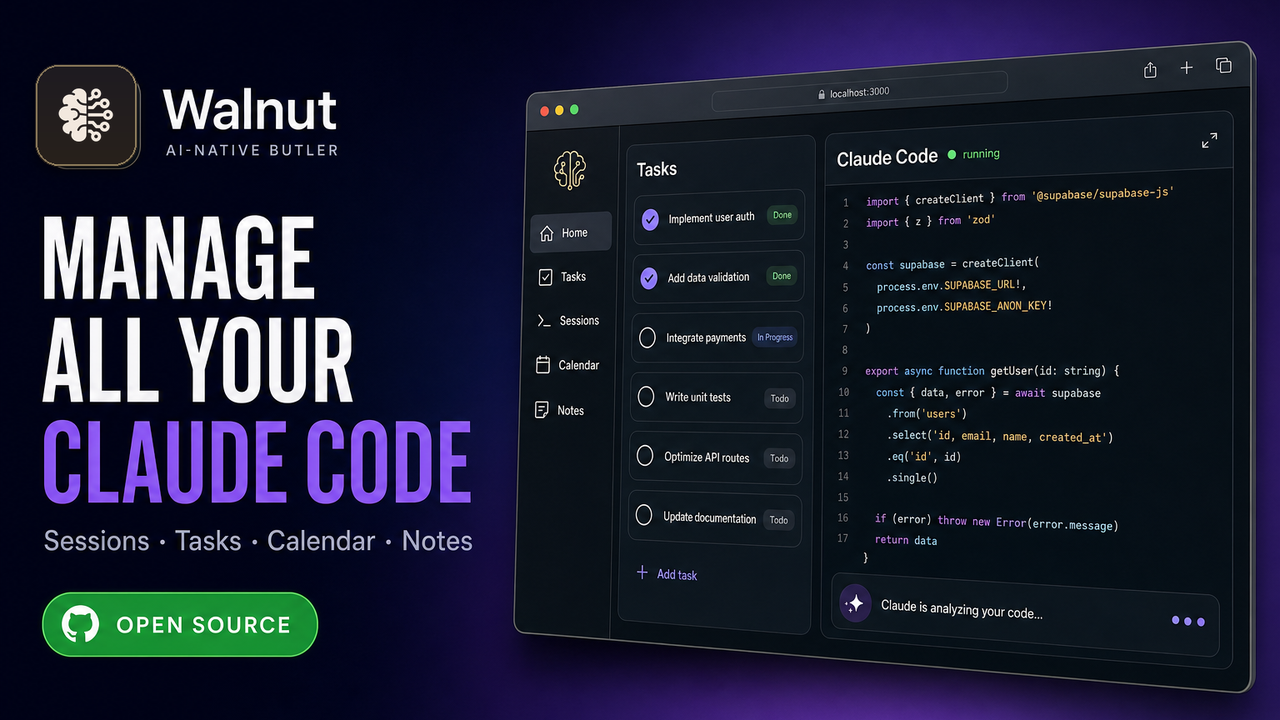
Walnut is an open-source workspace for managing Claude Code sessions from a single browser-based console. It brings tasks, agent conversations, live session output, files, terminals, notes, and code review into one interface rather than spreading work across terminal tabs.
The application is local-first and stores its data in JSON, Markdown, and SQLite without telemetry or a cloud database. It is MIT licensed and requires Node 22 or later together with the Claude Code CLI.
Session and Task Management
A natural-language request can become a task with an attached Claude Code session, while tool calls and output stream live in the browser. Sessions support chat, CLI-style mode switching, a terminal, file browsing, message recaps, sub-session forking, mid-session model switching, and plan-to-execution workflows.
Tasks use a Category, Project, Task, and Subtask hierarchy with priorities, due dates, dependencies, and tags. Focus, Satellite, and Wait areas separate active, secondary, and blocked work, with color-coded status updates as agents run.
Review and Multi-Agent Workflows
Walnut reconstructs a per-session diff from session history, keeping changes attributed when multiple agents share a repository. Diffs can be viewed in split or unified form and grouped by repository; selected code can be sent back to the same agent, while line comments can be collected into a review.
Dynamic multi-agent workflows appear as a live flow graph. Parallel and sequential phases show each subagent's status, model, token usage, and duration, and their transcripts remain available after reload from the on-disk manifest.
Remote Work, Memory, and Automation
One console can operate sessions locally and on multiple SSH hosts. Walnut detects the remote Node version, deploys its daemon, and reconnects to still-running processes after a tunnel or daemon interruption; terminal, file, diff, and command-palette features also work remotely.
Its local notes vault supports Markdown, wiki-links, backlinks, folders, and hybrid BM25 and vector search. Working memory is updated during use, while a background agent distills daily logs into searchable topic pages. Built-in automation covers one-time, interval, and cron-expression jobs with timezone support, and task synchronization is provided through plugins, including Microsoft To-Do and Jira.