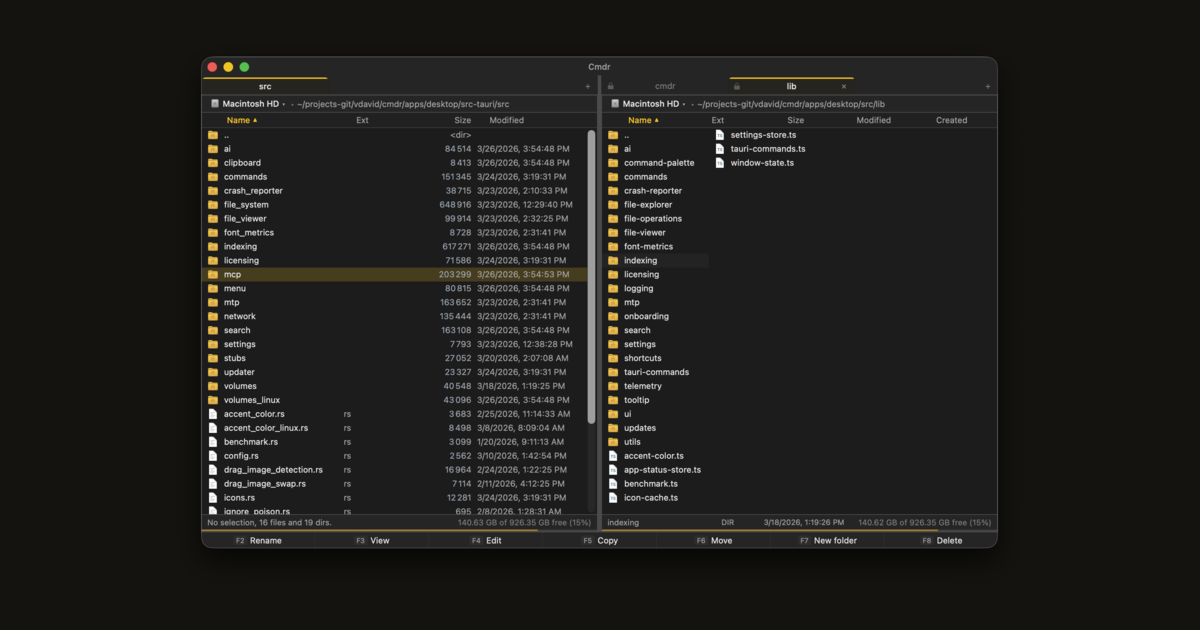
Overview
Cmdr is a two-pane file manager built for macOS power users. Written in Rust, it combines keyboard-driven file operations with a live full-disk index that supports instant search and displays folder sizes throughout the interface.
The app is currently in open beta and works with either keyboard or mouse input. Its optional AI capabilities can run through a downloadable on-device model or through a user-provided model API key.
Key Features
- Indexes the full drive once and keeps the index current across restarts.
- Opens large folders while showing icons, sizes, and dates.
- Supports keyboard-first navigation, selection, copying, moving, renaming, menus, tabs, settings, and a command palette.
- Offers smart search using natural-language descriptions of files.
- Provides natural-language batch renaming without requiring regular expressions or scripts.
- Generates file organization suggestions that users can approve or reject.
AI and Search Capabilities
Smart search can interpret requests such as finding a recent contract or locating folders with a particular name. Cmdr also supports commands that transform filenames, including changing case or adding a date prefix.
For file organization, the app can propose moves and deletions rather than applying them without confirmation. The included local model is designed for private, on-device use, while external model keys can be used for more capable results.
Availability and Pricing
Cmdr is free for personal use and does not require signup or an account. Work use is offered for a one-time price of $59, and the source is available under the BSL 1.1 license.
The downloadable macOS version supports Apple Silicon, Intel, and universal builds. macOS 12 or newer is required, while macOS 10.15 and 11 are supported on a best-effort basis; Linux is in self-build alpha and Windows support is planned.