Overview
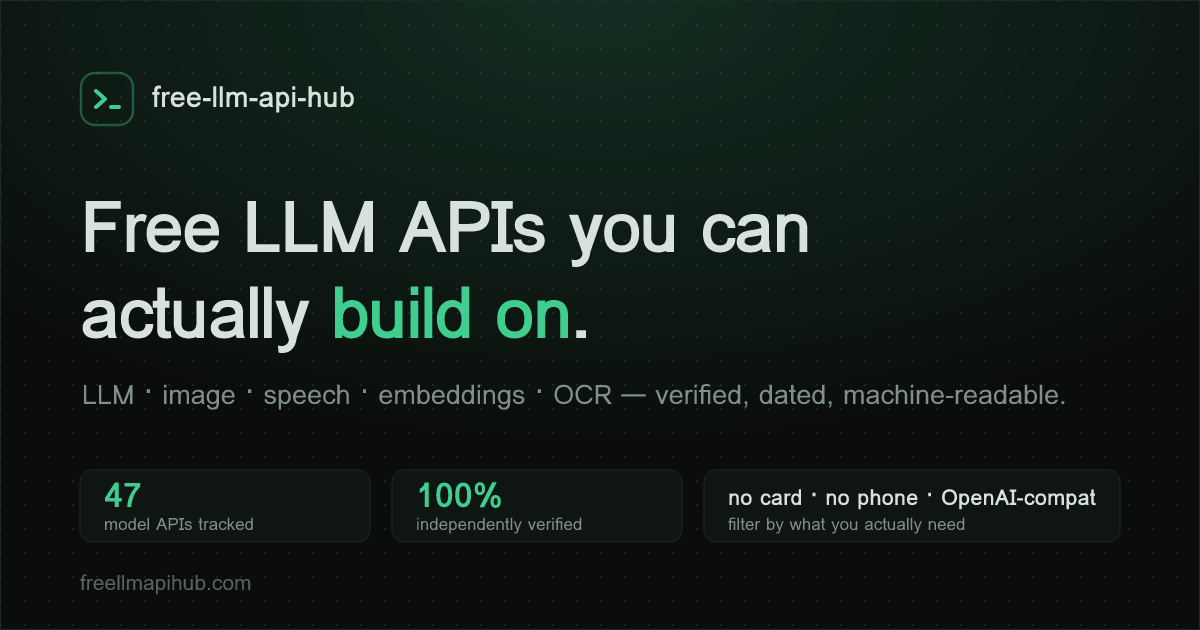
Free LLM API Hub is a continuously verified dataset for developers comparing free AI APIs and one-time trial credits. It brings provider allowances, API types, restrictions, and verification dates into one sortable resource.
The collection extends beyond language models to services for embeddings, reranking, OCR, document parsing, speech, images, video, audio, and 3D generation.
What the Dataset Covers
Entries distinguish ongoing free access from non-renewing trial credit and summarize what each provider offers. Coverage includes providers with OpenAI-compatible interfaces as well as services using native REST or WebSocket APIs.
Each listing highlights practical constraints such as daily or monthly limits, model availability, account or card requirements, commercial-use terms, data-use policies, attribution, geographic availability, and paid overages.
Comparison Features
The provider listing is structured to help developers compare several facts consistently:
- API type and the workloads each service supports
- The free allowance or signup credit
- Important limitations, terms, and usage conditions
- The date on which the information was verified
Column headers are sortable by keyboard with Enter or Space. Within rows, arrow keys move between providers and Enter opens the selected entry.
Free Tiers and Trials
The dataset makes an important distinction between ongoing plans and trial offers. Ongoing options range from fixed daily or monthly quotas to rotating free-model catalogs and community-powered capacity, while trials generally provide a one-time credit that does not renew.
Conditions vary substantially by provider. Some offers require no card, some limit production or commercial use, and others impose model-specific terms, data-training policies, attribution requirements, or usage caps. Developers can use these details to evaluate whether an offer fits a prototype, research project, or longer-running application.
Developer Relevance
Free LLM API Hub is designed as a comparison starting point rather than a single API provider. By presenting allowances alongside their catches, it helps developers assess both technical coverage and operational restrictions before selecting a service.
The verification date attached to every row also gives readers context for offers whose models, quotas, or terms may change over time.