Overview
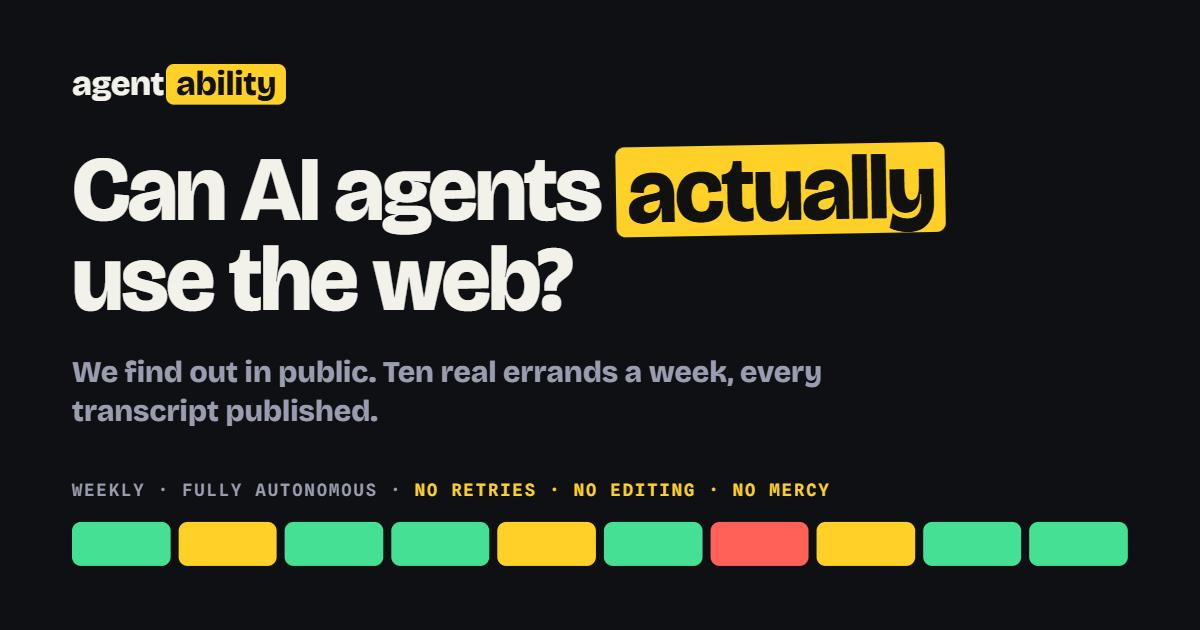
Agentability is an open experiment that measures how effectively AI agents can use the public web. It gives an agent everyday research errands, records successes and failures, and publishes the resulting transcripts without retries or editing.
The project also maintains an AI-readiness index for 113 well-known websites. Together, the episodes and site audits show both what an agent can accomplish with ordinary web requests and where technical or policy barriers prevent access.
How the Experiment Works
An AI producer turns current search interests into ten practical errands, such as finding an event time, checking a reported fact, or comparing available information. The agent attempts those tasks using read-only HTTP requests without JavaScript, forms, logins, or human assistance.
Every outcome is retained, including incomplete attempts and encounters with bot protections. This methodology is intended to make the results reproducible and expose the gap between content that works in a browser and content an automated assistant can actually retrieve.
Website Readiness Audits
Each site is checked weekly against conventions and access conditions relevant to agents. The audit covers signals such as crawler policy, readable page content, structured data, MCP support, and the presence of an llms.txt file. Public reports assign a score and identify a concrete correction for each failed check.
The ranked index connects those technical findings with observed task failures. This makes it possible to compare declared crawler access with practical usability during real information-gathering attempts.
Open Data
Agentability publishes its current summary, full leaderboard, historical weekly snapshots, and raw per-site results as plain JSON with CORS enabled. The data requires no key or signup, and the evaluator is a small dependency-free TypeScript program designed to reproduce the published measurements with ordinary HTTP requests.